The Changing View of the Learning Landscape
Reflecting upon a recent interaction with a colleague where the use of technology in education was challenged, I am left considering whether the viewpoint has legitimacy, or whether the view of ‘how it has always been’ is seen through rose coloured glasses. Downes (2017) suggests that societal change is gradual but change to individuals is abrupt and confronting; is how we respond to such change the main contributor to our opinion on this topic? The challenger referenced how, in their substantial teaching experience, they have witnessed many new ideas that have turned out to be nothing more than whims. This discussion will examine the social, cultural and economic impact of the digital age on tertiary education as well as reflect upon the changing architecture of participating afforded by digital technologies.


It is important to first acknowledge the change that has occurred in education over a period of time and across a range of impacting factors. The first, and arguably greatest impact has been the increased in educational attainment. The graph below, produced by the OECD shoes are marked increased the percentage of adults who have attained a given level of attainment (Gurria, 2011) . Gurria (2011) further comments that counties with traditionally low attainment levels have improved their results significantly to be on par with traditional high attainment level countries such as the United States, much of which has been attributed to the publishing of key educational indicators that have identified concerns and brought about action to prioritise and invest in education. This increase brings with it many benefits but also many challenges including the need to increase and improve infrastructure as well as meet the needs of a broader range of society (e.g. interests, abilities etc).

Before the introduction of a formalised, structured learning environment, children learned through experience either the home or work (predominantly agricultural and factories) environment (Gray, 2008) . The first education revolution saw the establishment of mass public education around 200 years ago, however little has changed from its industrial view point today (Gidley, 2012) . The prospects and challenges being bought about by the introduction of digital technologies, is being viewed as the second education revolution. This process has caused tensions between traditional teaching methodologies and the opportunities being afforded by technological advances (Collins & Halverson, 2010) . Given that many of these advances have occurred within the past decade, it gives cause to the opinion of many experienced educators that the two, education and technology, are not a good fit and therefore are likely to go their separate ways.
The final factor to be briefly examined, is that of data and administration. With the increased student numbers and closer scrutiny on the use of public funds, the need to prove beneficial outcomes has become every present. Throughout the past 100 years, a vast array of systems, data collection process, analysis tools, pedagogical theories, government policies and curriculum guidelines (just to name a few) have sought to create a positive transformation in learning development (Hoffert, 2017) . Some of which have been successful, and others have left educators change weary and wary.
As indicated above, scholars argue that in the majority of schools, the classroom functions much like the ones of over a century ago in the industrial era, teach specific tasks, schedules and behaviours rather than those identified by the World Economic Forum as the skills required for today and into the future (McShane, 2015) .

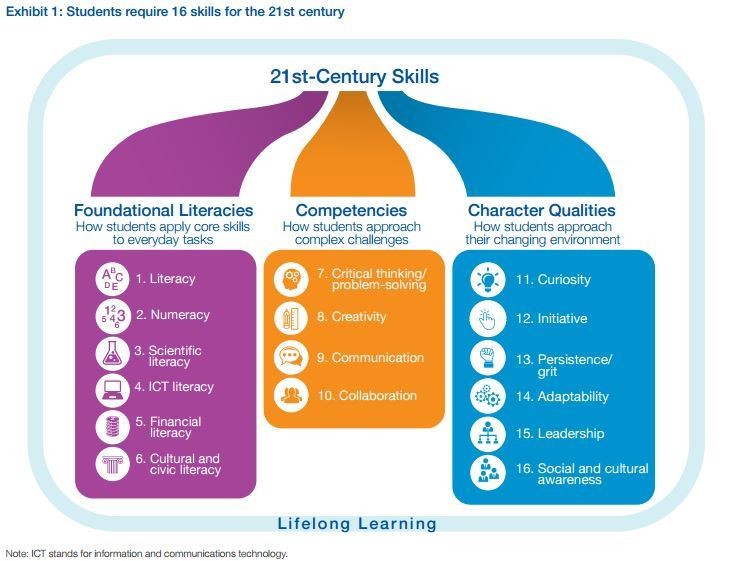
McShane(2015) goes onto to document that the idea of extended written response (essays etc.) may be questionable in terms of a legitimate assessment technique if it does not allow students to demonstrate the knowledge, skill and understanding in an authentic, 21stcentury way. These traditional approaches to teaching, learning and assessment have been shown lacking when compared with newer approaches such as the guided inquiry method associated with constructivism (Vlassi & Karaliota, 2013) . With this in mind, educators are also seeking a way to adapt to the needs of millennial learners who demonstrate a decreased tolerance for lecture-style teaching (Prensky, 2001) . Incorporation of active learning strategies, such as flipped classrooms and virtual collaboration space, that are supported and facilitated by technology should be considered as way to deliver curriculum content and develop 21stcentury skills in the student (Roehl, Reddy, & Shannon, 2013)
Using technology to build innovation and make education more student centred is key to moving forward but there are barriers (Moyle, 2010) and it is important to have a clear understanding of technology means within the educational context. Technology includes both the tools and methods used in teaching and learning. In the classroom that may include digital devices (e.g. mobile phones and interactive whiteboards), virtual or remote access (e.g. video streaming or e-portfolios), blended learning structures or gamification of a subject (Fondation Telecom, 2014) . Each of these technologies must be selected with the available resources, student cohort and subject matter front of mind to ensure that the usage is both effective and efficient in achieving the desired result.
It must be acknowledged that whilst there are many benefits associated with the introduction of technology into education, it is not without its limitations (Downes, 2017) , and these should be considered as part of this discussion. Overall research has shown that the impact of digital technologies has been positive whilst the long-term implications remain a little more unclear (Higgins, Ziao, & Katsipataki, 2012) . The four key areas that should be considered when assessing the impact of the digital age on tertiary education are social, cultural, economic and equity. Each of these will be briefly examined on its on below, however I caution that in real terms, they should be considered holistically and from a balance viewpoint to determine the impact on each individual circumstance.
Let’s first address the social impact of digital technologies and for many people the term ‘social media’ will spring to mind and following quickly behind will be ‘cyberbullying’. By no means is this discussion going to down play the effects of cyberbullying however research has shown that the access to a device and its use in an educational setting does not increase the chance of a user becoming a victim (Schurgin O'Keeffe & Clarke-Pearson, 2011) . Furthermore, these authors state that “online harassment is not as common as offline harassment, and participation in social networking sites does not put most children at risk”. The functionalities of technology in the social media and networking space have been shown to cultivate cognitive capabilities, foster knowledge flow and enable personal understanding at a higher level (Siemens, 2014) . All of these factors combined with collaborative space and the ability to learn anywhere, anytime mean that students are not restrictions in their scope of learning practices.
The second consideration concerns culture; how much it impacts technology adoption and how it is impact by it. Research indicates that depending on the type of culture, driven by innovation or imitation, determines how quickly new technologies are adopted into society (Lee, Trimi, & Kim, 2013) , and by default into the education system. Sustainability in these systems is further ensured by the interaction between cultural and institutional (e.g. political or educational facility) support including where the driving force for adoption is coming from(Eseonu & Egbue, 2014) . Moreover, digital technology has opened the doors for a variety of innovative ways to interact, share information and meet like-minded people from next door and around the world (Pookulangara & Koesler, 2011) . Whilst many may argue that this has diluted cultures into bigger, more homogenous groups, research suggests otherwise. Combi (2016) defines culture as a set of communicative acts and that technology is not only the system but is the whole set of relationships between human beings, utensils and fields of knowledge. The observations include that whilst technology may change the how, where and when of communication, they still continue to occur in other places, suggesting that the level of storytelling is actually increasing, it is being document (in some cases for the first time) and that culture is placing demands on technology (e.g. country names) to ensure that it survives (Combi, 2016) . The discussion here has focussed on cultural more broadly however it has impact on the classroom and staffroom cultural as well. How positive or negative the impact is can often be attributed to the leadership and management of community expectations (Desforges, 2018) , and as such is outside of the scope of this essay.
The question of economic impacts bought about by the digital age vary greatly depending on the community within which the discussion is situated. The complexity of the technology and how it is embedded into the out-of-school culture also plays a role (Cloete, 2017) . My experience has shown that even in one of Australia’s lowest socio-economic areas, the selection of an appropriate devices with community education can lead to outstanding levels of device take up. Factors such as robustness, value for money and flexibility must be considered when recommending a device for students to purchase, or organisationally owned equipment. Providing specific parameters can also help in reducing equity related economic issues as there is often a limited number of devices that fit the requirements and therefore students can establish a ranking system as easily. As devices last longer, expand in their functionality and come down in price, the feasibility for students to purchase them improves. As educators though, we have a role to play in ensuring that the devices are in fact used to ensure students receive value for money. On a broader spectrum, the impact of not using technology is of greater concern because students will not be prepared for the world of work which leads to un- or under-employment, again leading to much larger economic impacts.
Digital device access is growing however nearly sixty percent of the world’s population remains offline (Poushter, 2016) . Research has shown that a mixed-mode modal of delivery enhanced opportunities but only when other support systems are in place to ensure access to technology, lifestyle factors and motivation to learn are addressed (Reedy, 2011) . These factors, along with social wellbeing, cultural awareness and economic impacts must be considered when using technology in the education arena. The benefits have been shown to far outweigh the risks and potential disadvantages. Given that many of the factors have been discussed above, this overview with focus on equity from a disability or complex student needs perspective. Improvements have been recorded in cognitive abilities, knowledge acquisition and retention, behaviour, communication and relationship through the use of technology, in particular in the use of customisable settings and adaptable applications (Fernandez-Lopex, Rodriguez-Fortiz, Rodriguez-Almendros, & Martinez-Segura, 2013) . Under Australian legislation, all students need to be given equal access to education opportunities and technology allows for content to be delivered and assessment to occur in ways that can be adapted to meet the needs of the student (Ayres, Mechling, & Sansosti, 2013) . The other area, that from experience needs to be mentioned, is that for students in regional or remote areas, technology can be used to form connections and open pathways to future study or employment that otherwise would not have been available.
As an educator, we all strive to one common goal, that being to prepare our students for a future world in which they can be a success. Our focus therefore, and the examples that follow, suggest that we should be facilitating a student’s discovery of the ‘new’ from the familiar (Downes, 2017) . A sense and skill for discovery is key to becoming a lifelong learning, and part of this is the ability to innovate and collaborate, both of which have been suggested as the long-term impact of technology introduction (Adams Becker, et al., 2018) . There are many techniques, founded in technology, some that are outlined below that have been shown to foster these skills and establish students as keen learners.
Firstly, I refer back to my early post titled ‘Badges or Bust’, which examined the benefits and feasibility of introducing a badging, or micro-credentialing system. Digital badges provide new affordances for learning activities and when used effectively have been shown to motivate continued engagement (particularly through recognition and evidence of learning), increase ‘on-task’ time and improve skill development (Gibson, Ostashewski, Flintoff, Grant, & Knight, 2013) . All of these factors support both the practices of the teacher and the student in achieving the best possible outcome for the individual learner.
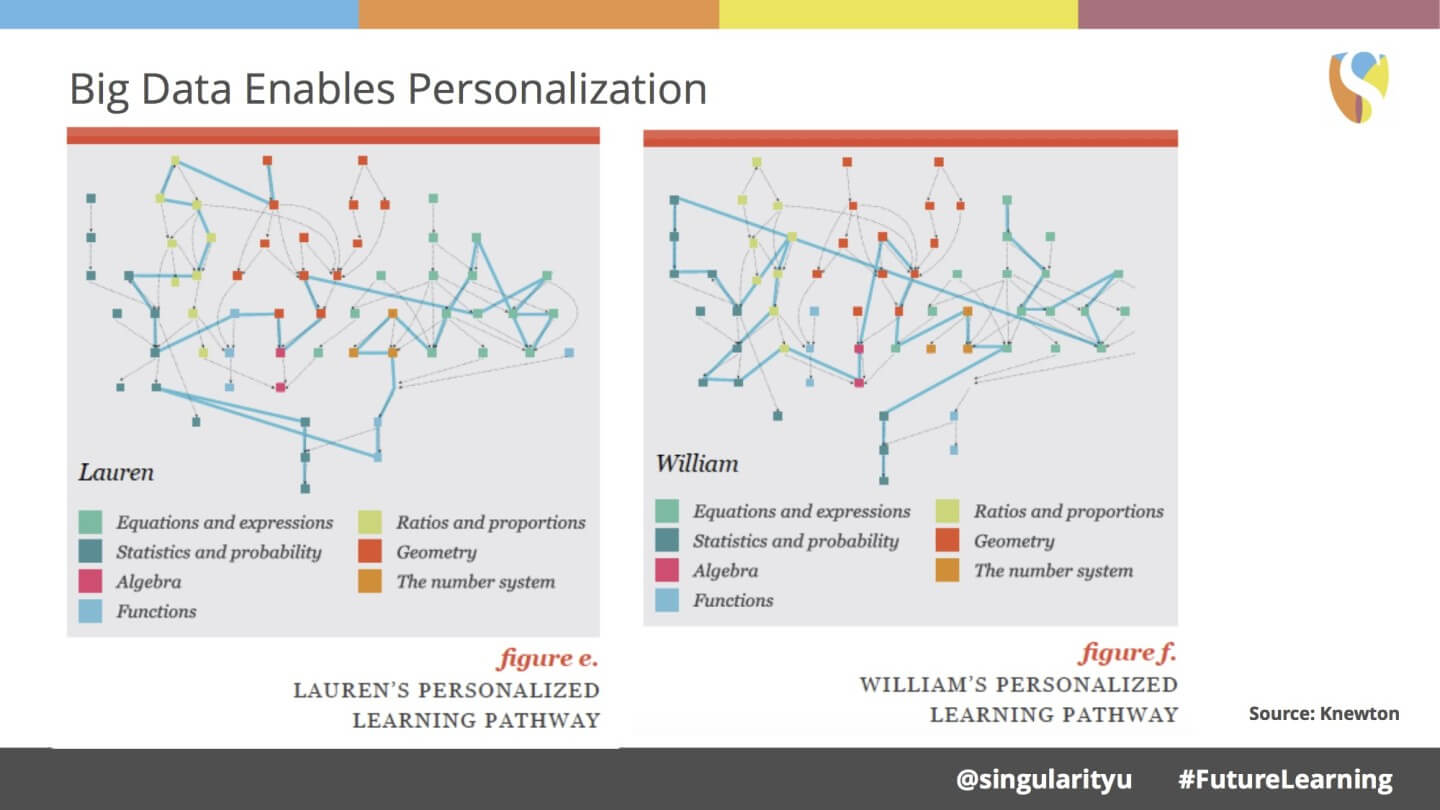
The second point that demonstrates the importance and relevance of technology in today’s education arena is that of data and its subsequent analysis. Since the very earliest of days in education, data has played in an important role, although traditionally it has been about the final outcome, the student’s grade. With the introduction of technology, the role of data is being more effectively and efficiently used to improve teaching and learning through the analysis of the student’s digital footprint (Sclater, Peasgood, & Mullan, 2016) . A digital footprint is a collection of information about an individual as a result of their online activity and in the education space that may include how many times they have watched a video, short quizzes to check for understanding or the collaboration with other students. Reviewing this information has been shown to assist educators identify students at risk of attrition, develop more effective intervention programs, support students with varied or complex needs (see image below as an example) and extend the more advance students (Sclater, Peasgood, & Mullan, 2016) . Again, all key elements in improving the learning outcomes of students with the added bonus of meeting the data needs of administrations and organisational leaders.

Source: https://singularityhub.com/wp-content/uploads/2015/11/futurelearningdeck_copy-dragged-1440x810.jpg
The world of digital learning not only offers benefits to the individual learners as outlined above, it offers significant opportunities for the teaching and learning industry as a whole. The ability to ‘scale’ educational products and services through technology has been key to increasing the participation in learning. Cisco Networking Agency state that more than 170 million exams have been taken through their assessment bank, something unachievable through traditional methods (Frezzo, 2017) . Furthermore, digital technologies assist in overcoming many of the traditional barriers (real and perceived by the individual) to accessing education at any time of life such as family responsibilities, financial, location, age, language, physical ability, employment and pre-requisite knowledge (Mason, Fleming, Paxton, & Singh, 2017) .
Studies have shown that a wide variety of technologies (devices and methods) can increase participation, engagement, reflective thinking and collaborative learning. Examples include micro-blogging (Gao, Luo, & Zhang, 2012) , personal learning environments (Dabbagh & Kitsantas, 2012) and virtual reality (Pantelidis, 2010) . All of these techniques and many more have been shown effective, but never without the proper structure and guidance of a skilled educator who understands the relevance of the device being used.
If you are more of a visual person that is interested in some key technology adoption and online learning participation rates, the following resources may be of interest:
- EdTech Magazine has published some interesting infographics that outline where technology has been widely adopted and its distractions.
- NerdGraph has produced a resource revealing how public and private institutions (in America) are navigating the world of online higher education.
Research into the use of teaching and learning technology is by no means suggesting that face-to-face interactions be confined to the history books, rather, that purposeful adaption of teaching practices to incorporate its use can lead to an enhanced learning experience (Verenikina, Jones, & Delahunty, 2017) . When offered the opportunity to engage with something new, we should be asking ourselves the following questions (Szlichta) :
- What does it do better?
- What does it replace?
- What does it retrieve?
- What could it become?
Frezzo(2017) states that by 2020 there will be 1.5 million new digital jobs and 90% of organisation have an IT skills shortage but the education industry feels ill equipped to meet their needs given the knowledge and ability gap. Likewise, employers report difficulties finding workers with the 21stcentury skills outlined earlier such as problem solving and communication (Winthrop, Williams, & McGivney, 2016) . As educators we must adapt our practice to ensure that we model the skills, attitude and abilities required to make our students successful.
So, what do I say to my colleague next time they dismiss the idea of technology in education? Well I say… thanks but I think I am going to look forward rather than back. I won’t forget where education has come from because there are important lessons to be learnt about the critical role the enthusiastic educator has to play in motivating students to engage with learning, beyond even their course of work. I will be sure to not dismiss or adopt something just because it is shiny and new but take it on board because it merits it and will benefit my students, the organisation and my ability to be an affective educator. I challenge them to reflect on their practices as an educator and as a teacher, particularly around what role technology plays in their own lives. Technology, in all its guises is here to stay, and I for one am excited about where it will take us.
As a very wise man once said, let it take us to “infinity and beyond…”.


References
Adams Becker, S., Brown, M., Dahlstrom, E., Davis, A., DePaul, K., Diaz, V., & Pomerantz, J. (2018). The NMC Horizon Report: 2018 Higher Education Edition.Louisville: EDUCAUSE.
Ayres, K. M., Mechling, L., & Sansosti, F. J. (2013, March). THE USE OF MOBILE TECHNOLOGIES TO ASSIST WITH LIFE SKILLS/INDEPENDENCE OF STUDENTS WITH MODERATE/SEVERE INTELLECTUAL DISABILITY AND/OR AUTISM SPECTRUM DISORDERS: CONSIDERATIONS FOR THE FUTURE OF SCHOOL PSYCHOLOGY. Psychology in the Schools, 50(3), 259-271.
Cloete, A. L. (2017). Technology and education: Challenges and opportunities. HTS Theological Studies, 73(4), 1-7.
Collins, A., & Halverson, R. (2010). The second educational revolution: rethinking education in the age of technology. Journal of Computer Assisted Learning, 26(1), 18-27.
Combi, M. (2016). Cultures and Technology: An Analysis of Some of the Changes in Progress - Digital, Global and Local Culture. In K. Borowiecki, N. Forbes, & A. Fresa, Cultural Heritage in a Changing World.Springer.
Dabbagh, N., & Kitsantas, A. (2012, January). Personal Learning Environments, social media, and self-regulated learning: A natural formula for connecting formal and informal learning. The Internet and Higher Education, 15(1), 3-8.
Desforges, R. (2018). How some edtech tools impact school culture.Retrieved from Studyo: https://studyo.co/edtech-tools-impact-school-culture/
Downes, S. (2017). Quantum Leaps You Can Expect in teaching and Learning in the Digital Age - A Roadmap. Retrieved 2019, from Contact North | Contact Nord: https://teachonline.ca/tools-trends/insights-online-learning/2018-02-07/quantum-leaps-you-can-expect-teaching-and-learning-digital-age-roadmap
Eseonu, C., & Egbue, O. (2014). Socio-cultural influences on technology adoption and sistainable development. IIE Annual Conference and Expo, (pp. 2711-2716).
Fernandez-Lopex, A., Rodriguez-Fortiz, M. J., Rodriguez-Almendros, M. L., & Martinez-Segura, M. J. (2013, February). Mobile learning technology based on iOS devices to support students with special education needs. Computers & Education, 61, 77-90.
Fondation Telecom. (2014). Higher Education in the Digital Age: Rise of the MOOCs.Fondation Telecom.
Frezzo, D. (2017, May 10). The role of technology in the education of the future. Retrieved 2019, from World Economic Forum: https://www.weforum.org/agenda/2017/05/science-of-learning/
Gao, F., Luo, T., & Zhang, K. (2012, August 24). Tweeting for learning: A critical analysis of research on microblogging in education published in 2008–2011. British Journal of Educational Technology, 43(5), 783-801.
Gibson, D., Ostashewski, N., Flintoff, K., Grant, S., & Knight, E. (2013). Digital Badges in education. Education and Information Technologies, 20(2), 403-410.
Gidley, J. M. (2012, February). Evolution of education: From weak signals to rich imaginaries of educational futures. Futures, 44(1), 46-54.
Gray, P. (2008). A Brief History of Education. Retrieved from Psychology Today: https://www.psychologytoday.com/us/blog/freedom-learn/200808/brief-history-education
Gurria, A. (2011). Education at a Glance.Retrieved from OECD: https://www.oecd.org/education/skills-beyond-school/48642586.pdf
Higgins, S., Ziao, Z., & Katsipataki, M. (2012). The Impact of Digital Technoogy on Learning: A Summary for the Education Endowment Foundation.Durham University.
Hoffert, K. (2017). Significant Changes in Education: Effects on Learning Approach.
Lee, S.-G., Trimi, S., & Kim, C. (2013, January). The impact of cultural differences on technology adoption. Journal of World Business, 48(1), 20-29.
Mason, C., Fleming, A., Paxton, G., & Singh, J. (2017). Lifelong Participation Through Digital Technology.CSIRO.
McShane, S. (2015, November 13). 3 Ways Exponential Technologies Are Impacting the. Future of Learning. Retrieved 2019, from SingularityHub: https://singularityhub.com/2015/11/13/3-ways-exponential-technologies-are-impacting-the-future-of-learning/#sm.000o1vdv116zscrqq0d16pahhxbst
Moyle, K. (2010). Building Innovation: Learning with technologies.Camberwell: ACER Press.
Pantelidis, V. S. (2010). Reasons to use virtual reality in education and training courses and a model to determine when to use virtual reality. Themes in Science and Technology Educations, 2(1-2), 59-70.
Pookulangara, S., & Koesler, K. (2011). Cultural influence on consumers' usage of social networks and its' impact on online purchases. Journal of Retailing and Consumer Services, 18(4), 348-354.
Poushter, J. (2016, February 22). Smartphone Ownership and Internet Usage Continues to Climb in Emerging Economies . Retrieved 2019, from Pew Research Center: http://www.pewglobal.org/2016/02/22/smartphone-ownership-and-internet-usage-continues-to-climb-in-emerging-economies/
Prensky, M. (2001). Digital natives, digital immigrants. On the Horizon, 9(5), 1-6.
Reedy, A. (2011). Equity in a digital world: engaging Indigenous learners. ascilite 2011, (pp. 1061-1074). Hobart.
Roehl, A., Reddy, S. L., & Shannon, G. J. (2013). The Flipped Classroom: An Opportunity To Engage Millennial Students Through Active Learning Strategies. Journal of Family & Consumer Sciences, 105(2), 44-49.
Schurgin O'Keeffe, G., & Clarke-Pearson, K. (2011). The Impact of Social Media on Children, Adolescents, and Families. American Academy of Pediatrics Clinical Report, 800-804.
Sclater, N., Peasgood, A., & Mullan, J. (2016). Learning Analytics in Higher Education: A review of UK and international practice.JISC.
Siemens, G. (2014). Connectivism: A Learning Theory for the Digital Age.
Szlichta, J. (n.d.). Computers and Media: McLuhan & Responsive Media.Retrieved from CSCI 1200 Computers & Media: http://data.science.uoit.ca/wp-content/uploads/2015/09/mc-2-mcluhan.pdf
Verenikina, I., Jones, P., & Delahunty, J. (2017). The Guide to Fostering Asymchronous Online Discussion in Higher Education.Retrieved 2019, from www.fold.org.au/docs/TheGuide_Final.pdf
Vlassi, M., & Karaliota, A. (2013). The comparison between guided inquiry and traditional teaching method. A case study for the teaching of the structure of matter to 8th grade Greek students.3rd World Conference on Learning, Teaching and Educational Leadership WCLTA 2012(pp. 494-497). Elsevier.
Winthrop, R., Williams, T. P., & McGivney, E. (2016, October 5). Skills in the digital age - How should education systems evolve?Retrieved 2019, from Brookings: https://www.brookings.edu/research/skills-in-the-digital-age-how-should-education-systems-evolve/
Comments
Post a Comment